The Many Notes Of Fariha Pervez
- 10 Oct - 16 Oct, 2026


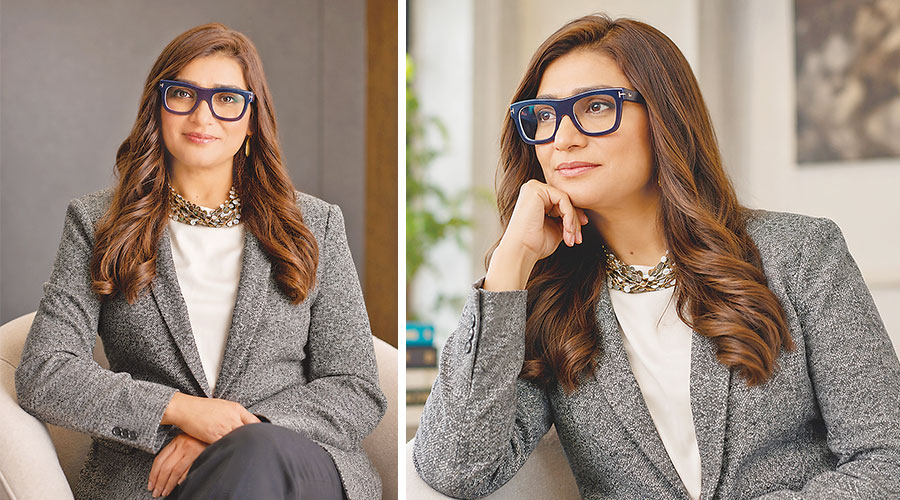
On Cyber Warfare, AI, Misinformation & Defending Pakistan in the Digital Age.
In an age where battles are no longer fought exclusively on borders and battlefields, the fight for security increasingly extends into the digital world. From cyber harassment and surveillance to misinformation, artificial intelligence and online censorship, the question of what it means to protect people has become more complicated than ever. Few Pakistanis have been at the forefront of this conversation as consistently as lawyer and digital-rights activist Nighat Dad.
As the founder and Executive Director of the Digital Rights Foundation, Dad has spent more than a decade challenging the threats women and vulnerable communities face online, while advocating for privacy, freedom of expression and a safer, more inclusive internet. Her organisation established Pakistan’s first Cyber Harassment Helpline, providing support to victims of online abuse.
Her influence, however, extends far beyond Pakistan. A TIME Next Generation Leader, TED Fellow and recipient of the Human Rights Tulip Award, Dad has taken Pakistan's digital-rights conversation to some of the world's most influential platforms.
For a woman who began her journey as a lawyer navigating a deeply patriarchal professional environment, her rise is remarkable. Today, she is helping shape conversations around technology, AI, privacy and human rights at an international level. In this conversation, Dad talks about women, power, technology, digital security and what defending Pakistan could mean in an increasingly connected world. This Defense Day, MAG catches up with the activist to get her thoughts on the most serious threats today and how to deal with them. Excerpts:
SK: You come from a conservative and rural family background. What was Nighat Dad like as a young girl, and what first made you question the limitations placed on women?
ND: [I am] a girl from a village in Jhang district. My parents had six children and they decided all six would be educated, and that decision was not an obvious one where we lived. It cost them something socially. My father in particular took positions that his own relatives thought were shameful, so the thing people expect me to say, that I grew up fighting my family, is not true. My family is the reason I am here. What I was fighting was everything around my family.
What I remember most clearly is noticing the gap between what I was told girls were capable of and what I could actually see girls doing. I had the sense that things were being decided about me by people who never asked me what I wanted.
SK: You have spoken about the difficulties of being a woman pursuing higher education and later practising law in Pakistan. What were some of the biggest obstacles you encountered?
ND: Studying law at a co-educational university was not an easy choice for a girl from my background. My father insisted on it against the advice of relatives, and I want to be honest – this was a privilege. We did not have money. The privilege was to have a father who would take that fight on.
The obstacles inside the profession were different. Family and criminal law in Pakistan is a world where women are present constantly as clients and almost absent as decision makers. I would sit in court and watch women who had come for their own hearings sit silently while a lawyer or a father or a brother spoke for them. Some were not permitted to attend the meetings at all.
That did more to shape me than any obstacle I faced personally. Watching that hopelessness week after week was not something I could walk away from.
SK: How did Digital Rights Foundation come into being?
ND: It was not a single moment. Two things converged in 2012. The first was that women had started coming to me with a problem the law did not recognize; they would tell me they were being followed online, sent things they had not asked for, that their pictures were being used against them. And when I told them this was harassment, many of them did not believe me. They thought it was simply the cost of being a woman with a phone. I went looking for a legal remedy and there was none.
The second was that the government blocked YouTube indefinitely, and there was nobody to ask ‘why’. No accountability, no process, nobody in Pakistan whose job it was to question a decision taken about millions of citizens without consulting a single one of them.
So DRF started as a very small answer to a very large absence. There was no organisation in Pakistan looking at digital rights, and there was certainly nobody looking at them through a gender lens. The Cyber Harassment Helpline came later, in 2016, and it came out of anger rather than strategy. It was funded with the Human Rights Tulip prize money.
SK: What was the biggest challenge in establishing DRF?
ND: Money, and I would rather say that plainly than say something more inspiring. The Tulip award money built the helpline and then it ran out. For a long stretch the helpline survived on small grants. You are running a service that women call to say ‘please save my life’, and you are simultaneously wondering whether it would exist in six months. That is the part of this work that never appears in the profiles.
The second challenge was legitimacy. In 2012, if you talked about digital rights in Pakistan, people took it as a hobby. No one understood the conversation. Convincing anyone that a woman being blackmailed with a photograph was a rights issue took years.
SK: Can internet shutdowns actually be justified in the name of national security?
ND: The honest position is that international human rights law already has a test for this, and shutdowns almost never pass it. A restriction has to be provided for in law, necessary for a legitimate aim, and proportionate to that aim. A shutdown fails on proportionality almost by definition, because it is a blanket measure. You are not switching off a threat. You are switching off ambulances, banking, families checking whether their relatives survived something.
And the evidence does not support the claim. Shutdowns are usually imposed around protests, elections and religious processions, which tells you what they are actually for. Where they are justified as preventing violence, the research fairly consistently finds they do not.
I have not yet seen a shutdown in Pakistan that has met the test. Not one. That is a different statement from saying no circumstance could ever exist, and I would rather be accurate than absolute. What I would insist on is that if a state does this, it must be in law, time-limited, narrowly targeted, publicly justified, and reviewable by a court.
SK: If you could change one thing about Pakistan's digital-security policy, what would it be?
ND: Independent oversight. Not a better law, because we have laws. Prevention of Electronic Crimes Act exists. The problem is not the absence of text, it is that the text hands very broad powers to bodies that answer to nobody outside themselves.
A cybercrime law written to protect women from harassment has been used against journalists and critics. That doesn’t happen by accident. It is what happens when you create powers with no independent body able to say ‘no’, no transparency about how often they are used, and no route for a citizen to challenge them.
SK: What should women be doing right now to protect themselves digitally?
ND: Three things, and I want to put them in the order that actually matters. First, know that what is happening to you is a crime and has a name. The single most common thing we hear on the harassment helpline is a young woman apologising for calling, because she has been told this is normal, or that it is her fault. It is not normal. Non-consensual use of intimate pictures is the most frequent threat we see, and it is very often someone she knew and trusted.
Second, the basics genuinely do work. Two factor authentication, a password manager, reviewing what your apps can see, thinking before you send an image to someone who could later use it. This is unglamorous and it prevents a very large proportion of what we deal with.
Third, do not give up. When women face harassment online the advice they get from everyone around them is to delete their social media accounts and lay low. Quitting the internet is not the answer. It is your space and you belong in it. Every woman who is pushed offline makes it easier for the perpetrator to harass the next one. Call the helpline; it is free, it is confidential, and nobody on the other end will judge you.
SK: Has activism ever made you feel exhausted or disillusioned? Have there been moments when you've wondered whether the fight is worth it?
ND: Constantly. I would not trust anyone who said otherwise. There are days I take a call from a woman who is crying and asking us to save her life, and we cannot do very much. We are a small organisation with a phone line, and sometimes the honest answer is that we have no power over the situation she is in. Sitting with that helplessness is the hardest part of the job and it does not get easier with experience.
Qandeel Baloch's murder shook me in a way I did not expect. I saw a great deal of myself in her. Similar background, both of us left abusive marriages, both of us became loud in public in a country that punishes loud women. She did what she wanted to do, and not every woman in Pakistan can do that. I keep going. But I have stopped pretending the cost is small, and I have stopped telling younger activists that it is.
SK: What is one misconception people have about you?
ND: That I am at war with my family and my culture. That is not true. My parents could not read, and they educated six children. My father defied his own relatives so that I could leave a marriage, keep my son, and study law with men in the same classroom. He is the most feminist person I have known and he had no education at all. It tells you that you do not need all this education to be a feminist. When people cast me as someone who escaped her background, they erase the people who made the escape possible.
SK: Do you worry that younger generations are becoming so accustomed to surveillance that they no longer question it?
ND: I worry about it, but I want to be careful, because I think that story is often told incorrectly. The version I reject is that young people do not care about privacy. That is not what I see. Young people in Pakistan care enormously about who can see what, they simply calculate it socially rather than politically. A young woman managing three accounts with three different audiences is doing sophisticated privacy work. She has a very precise sense of who must not see what.
What is missing is the connection to state power. She will think hard about whether her cousin can find her profile and not at all about what her telecom operator retains or who can request it. Surveillance by family is vivid. Surveillance by institutions is abstract.
And the real risk is not apathy, it is normalisation of the infrastructure. Biometric registration to buy a SIM, expanding facial recognition, data collection with no meaningful data protection law behind it. Each step seems small. A generation that has never known anything else has no baseline to compare against, so nothing feels like a loss. That is why digital literacy has to include political literacy. Otherwise, we teach people to protect themselves from each other while the larger things go unexamined.
SK: Do you believe that international organisations genuinely understand the realities faced by women in countries like Pakistan?
ND: Sometimes, but there is a pattern I have spent years objecting to. You cannot write a digital security guide based on what you imagine the Global South to be – send it to us, and tell us it is for us. That has happened repeatedly. Advice built for a context where the threat is a stranger or a state, delivered to women whose threat is a brother. Guidance that assumes you can go to the police. Tools that assume you own your own phone.
The most common failure is not malice, it is a missing question. What happens to this woman if her family finds out. If you do not ask that, everything downstream is wrong. What has improved is that some platforms now maintain escalation channels for cases where a woman's life is in immediate danger, and that only happened because organisations from this region pushed for years.
SK: Is Pakistan prepared for the social and security implications of AI?
ND: No, and I say that as someone who worked on this at the United Nations level. We are not prepared institutionally. There is no meaningful data protection law in effect, and AI governance without data protection is a house without foundations. We do not have regulators with the technical capacity to assess these systems. We do not have procurement rules that would stop a government department deploying something nobody has evaluated.
We are not prepared socially either, and this is the part that concerns me more. Synthetic intimate imagery has already changed the threat landscape for women in Pakistan. Previously a blackmailer needed a real photograph. Now he needs a face. In a culture where the false accusation alone can end a woman's life, the fact that an image is fabricated offers almost no protection because the harm happens in the gap before anyone verifies anything. We are seeing these cases on the helpline now.
SK: Where do we draw the line between controlling misinformation and controlling free speech?
ND: The central issue is not defining categories of speech but determining who holds the power to decide and how their decisions can be challenged. In Pakistan, speech restrictions are often justified as fighting misinformation, but such rules frequently expand to suppress anything inconvenient to those in power. Disinformation, especially gendered campaigns targeting women, is genuinely harmful and effective at silencing public voices.
Solutions should focus on structural reforms, transparency about coordination and amplification, systemic accountability, independent decision-making bodies, and clear appeal processes for removed content. Ask yourself: Would you support these powers if wielded by a government you fear? If not, they shouldn't exist.
SK: Should governments have access to citizens' digital information in the name of national security?
ND: In principle, with strict limits, yes. States do have legitimate security functions. I am not going to pretend otherwise. In practice, in Pakistan, the powers that exist far exceed anything those limits would allow, and I want to be precise about why.
The safeguards that would make state access legitimate are prior judicial authorisation, individualised suspicion rather than bulk collection, narrow scope, time limits, notification to the person afterwards where possible, published statistics on how often these powers are used, and an independent body that can actually say ‘no’. We have very little of that. What we have is broad statutory power, wide discretion, and almost no transparency about the volume of requests going to telecom companies.
And there is a specific harm that gets overlooked in the abstract debate. Surveillance capability in a patriarchal state on data about a woman's movements, her calls, her contacts, is exactly the material that gets used against her by her own family.
So, the honest answer is that I do not oppose the principle. I oppose the current arrangement, and I would want anyone defending it to explain which of those safeguards they think we already have.
SK: What advice would you give young women entering fields where they see no women at the top?
ND: Four things; do not wait to feel qualified, because the people who are already in the room did not. I started an organisation in a field that did not exist in Pakistan, with no funding and no template, and I was not qualified either. Nobody is the first time.
Find your people early, and understand that they may not be in your field. The women who kept me going were not all lawyers or technologists. What you need is people who will tell you the truth and take your side, and that is a smaller and more valuable category than a professional network.
Expect the criticism to be about something other than your work. When you are visible as a woman, the attacks will be about your character, your family, your appearance, your morality. They are aimed that way because that is where they work. Recognising the pattern is what stops it from landing.
And do not let the absence of women above you convince you the absence is natural. It is not. Someone has to be the first, and being first is unpleasant and lonely, but it makes it slightly easier for the next one. That is the whole mechanism. There is none other.






COMMENTS