WHEN THE JOKE WAS ON ME PRANKS, PANIC AND UNEXPECTED TROUBLE
- 26 Sep - 02 Oct, 2026


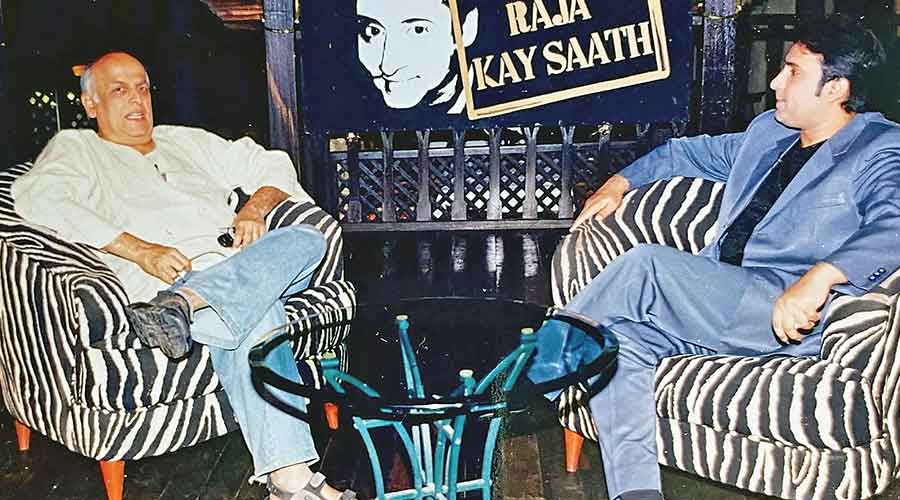
Mahesh Bhatt, Pooja Bhatt and Alia Bhatt are among the most recognisable names in Hindi cinema. When I first met Mahesh Bhatt, I asked him about the intriguing character of Maharani in his blockbuster film Sadak. He told me that, according to the original script, Maharani was meant to be a relatively simple transgender character. But as the film took shape, the character evolved into something far more powerful – eventually becoming one of the most dominant and memorable elements of the entire film.
Around 2004 or 2005, Mahesh Bhatt and his daughter Pooja Bhatt visited Pakistan, either on a private or film-related trip. The media went into a frenzy. Everyone seemed to be racing to get an interview with them first.
At that time, several satellite television channels had recently entered Pakistan, and competition among them was intense. My television programme, Raja Ke Saath, was quite popular, and I had already interviewed or hosted some of the country's most celebrated personalities, including Mehdi Hassan, Reshma, Anwar Maqsood, Shafi Muhammad Shah, Dr Muhammad Ali Shah, Mustafa Qureshi, Reema and Ghulam Mohiuddin.
A reception was organised at a bungalow in DHA, Karachi, in honour of Mahesh Bhatt and Pooja Bhatt, and I was invited to host the evening. A musical programme was underway, with prominent showbiz personalities, journalists and other distinguished guests in attendance, including Samina Peerzada and Usman Peerzada.
After quite a wait, Mahesh Bhatt finally arrived. To welcome him, I sang a line from one of his films:
"Tum aaye to aaya mujhe yaad, gali mein aaj chaand nikla."
He smiled.
Interestingly, Bhatt sahib had arrived without Pooja Bhatt. Apologising for the delay, he said, "All of you will have to wait a little longer for Pooja Bhatt. She'll be here shortly."
I couldn't resist.
"Mahesh ji, all these people are sitting here for pooja."
I then added, "It seems everyone's pooja is going to be late today."
The joke made its way into several newspapers, with some carrying it in bold headlines.
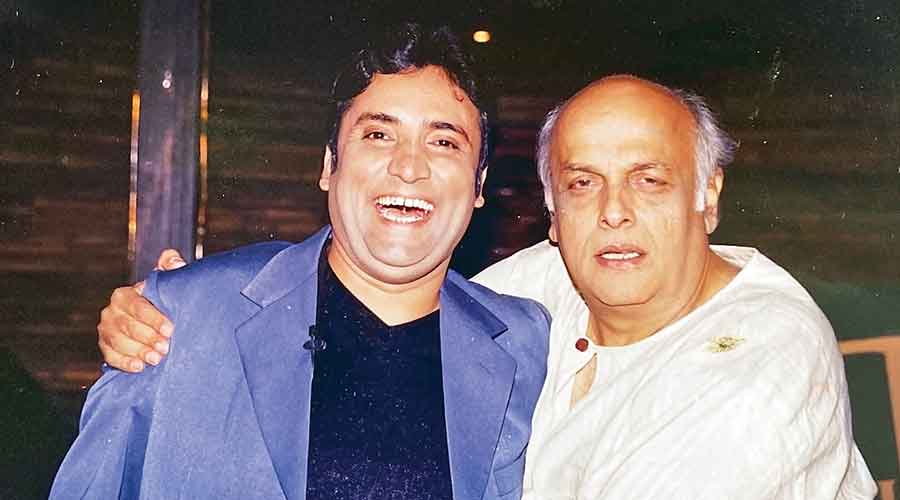
Later, when I invited Bhatt sahib onto the stage, we exchanged some light-hearted banter. He thoroughly enjoyed it and complimented my sense of humour.
"Your comedy is offbeat comedy," he told me. "You're not just difficult to catch; you're impossible to catch."
We both laughed, and that moment marked the beginning of our friendship.
Taking advantage of the opportunity, I invited him to appear on my show, Raja Ke Saath.
"Pakistan mein daawaton ka ek lamba silsila chal raha hai," he told me. "I'll confirm tomorrow."
The next day, I called him. He asked me to come to the Clifton residence of the owner of a prominent English-language newspaper.
"Come over and I'll tell you when we can record the show," he said.
When I arrived, Bhatt sahib and several other guests were sitting on the floor while a few musicians performed Sufi poetry in beautiful Sindhi, accompanying themselves on the ektara.
Bhatt sahib gestured for me to sit beside him. He had a genuine love for Sufi music.
After almost an hour, I finally asked, "So, which day shall we record the programme?"
He looked at me and said, "Hanif mian, I have an eleven-o'clock flight to India tomorrow morning."
"WHAT?"
I was stunned.
Bhatt sahib burst out laughing, apparently thinking my reaction was another part of my comedy.
"Bhatt sahib," I said, "I've already told my organisation that Mahesh Bhatt's programme will be on air this week. This has become a challenge for me."
He realised I was serious.
"Can you record it at seven tomorrow morning?" he asked. "I'm staying at the Marriott."
I told him I would need written permission.
Then, with considerably more confidence than logic, I said, "You go back to the hotel and get some rest. I'll be there to pick you up at five in the morning."
He looked at me.
"Where will you record it?"
"I don't know yet," I replied, "but the recording will happen."
That wasn't optimism. It was sheer determination speaking through me.
Bhatt sahib laughed again. Perhaps he thought I was being a little crazy. From his experience, he probably knew that arranging a television recording at such short notice was virtually impossible.
I didn't sleep that night.
Instead, I spent the entire night arranging the recording.
At exactly five in the morning, I was at the Marriott Hotel, asking reception to connect me to Bhatt sahib's room.
Within minutes, I was sitting in his room having tea while he shaved in the bathroom. The door was open, and perhaps because he had run out of shaving foam, he appeared to be using ordinary soap. The loud scraping of his razor echoed through the room.
I called out, "Bhatt sahib, are you shaving or harvesting a millet crop? What a noise! You should put a silencer on that razor!"
His hearty laughter came from the bathroom. A few minutes later, he emerged.
"Chaliye, Hanif mian."
I had rarely seen anyone get ready so quickly. When I asked him about it, he told me that he slept very little and was always quick to get ready. I was genuinely impressed.
I drove my own car to pick him up. At the time, the channel had no pick-and-drop facility for guests – a practice that became more common in Pakistan's entertainment industry only later.
Bhatt sahib was surprised.
"Here, even the biggest stars come and go on their own," I told him.
On the way, we talked about several Indian actors, including Shah Rukh Khan, Amitabh Bachchan, Naseeruddin Shah and Johnny Lever. He spoke particularly warmly about Shah Rukh Khan, Naseeruddin Shah and Johnny Lever as human beings.
After listening to me for some time, he suddenly said:
"Hanif Raja, I'm going to cast you in one of my films."
I thanked him, not knowing whether the remark was serious or simply another spontaneous moment between us.
Relations between Pakistan and India were relatively cordial in those days. Through my personal contacts, I managed to arrange the recording overnight at what was then the Carlton Hotel in Defence Phase 8, now the Ramada Hotel.
At exactly seven in the morning, the cameras rolled.
By nine, I had fulfilled my promise. The recording was complete, and I drove Bhatt sahib back to the Marriott, from where the hotel car was to take him to the airport.
In the lobby, Pakistani film star Meera was waiting to meet him.
In those two hours, I had somehow managed to extract enough material for two complete episodes. I had pulled it off.
Bhatt sahib, however, seemed less impressed than bewildered by the whole operation.
"Hanif mian, you had no prepared script, no technical arrangements, and yet you managed to get enough material for two episodes. If we had done this in India, we'd have needed another fifteen days after preparing the script. There would have been rehearsals as well."
I smiled and said, "Bhatt sahib, necessity is the mother of invention. Complaining about problems doesn't create resources. Determination finds a way through them. We Pakistanis are used to that."
I could sense that something had changed in his attitude towards me. There was genuine admiration and affection in his manner.
Bhatt sahib appeared remarkably generous when it came to appreciating talented and hardworking people, and during those few hours together, I found him deeply appreciative of Pakistanis and Pakistani artists.
He was a great admirer of Mehdi Hassan. He had also used Ghulam Ali's famous ghazal "Chamakte Chand Ko Toota Hua Tara Bana Dala" in his film Awaragi, picturising it on Anil Kapoor.
I told him that the ghazal was one of my all-time favourites and that I had probably listened to it nearly a hundred times – and could easily listen to it another hundred. He was delighted. He also expressed his admiration for Tasawwur Khanum's classic song "Agar Tum Mil Jao, Zamana Chhor Denge Hum."
A few months later, I heard that very song in Bhatt sahib's film Zeher, starring Emraan Hashmi. The female version was sung by Shreya Ghoshal and the male version by Udit Narayan. The song became hugely popular in India.
During the recording, I also told him that he should consider casting Shan Shahid in one of his films.
"Shan is an excellent actor," I said.
That conversation left me feeling genuinely proud of being Pakistani.
"Our showbiz industry may have a limited market and limited resources," I told him, "but the talent of Pakistani artists is limitless."
He agreed and affectionately patted me on the cheek. My memorable programme with Mahesh Bhatt can still be seen on my YouTube channel and Facebook page, Hanif Raja.
Even after returning to India, Bhatt sahib continued to call me on occasions such as New Year's and Eid to offer his greetings.
"Hanif Raja, when are you coming to India?" he would ask.
Eventually, however, our contact gradually became a casualty of the demands of everyday life.
A few years later, I travelled to India to participate in the comedy show The Indian Laughter Challenge. During one of the recording days at Yash Raj Studios in Mumbai, I happened to meet my favourite filmmaker, Yash Chopra, outside the studio canteen. He was extremely warm and gracious.
The following day, I spoke to Mahesh Bhatt on the phone. He was shooting one of his films some distance from Mumbai and warmly asked, "When are we meeting?"
Unfortunately, my Laughter Challenge rehearsals and recordings did not fit with his shooting schedule. I apologised for not being able to meet him and promised to see him when I returned for the show's next recording schedule.
But for several unavoidable reasons, I eventually decided not to continue with The Indian Laughter Challenge. And so, despite having been granted an Indian visa twice, I never returned. Not long afterwards, relations between Pakistan and India deteriorated once again, and my contact with Mahesh Bhatt eventually came to an end.
A few days ago, I came across a recent photograph of him on social media. He looked somewhat frail and unwell. But perhaps that is also the inevitable demand of age. I pray for his good health and a long, happy life. I remember Mahesh Bhatt as a compassionate, warm and friendly human being – a man with something of a darvesh in him. Perhaps, somewhere along the road of life, our paths will cross once again.






COMMENTS