WHEN THE JOKE WAS ON ME PRANKS, PANIC AND UNEXPECTED TROUBLE
- 26 Sep - 02 Oct, 2026


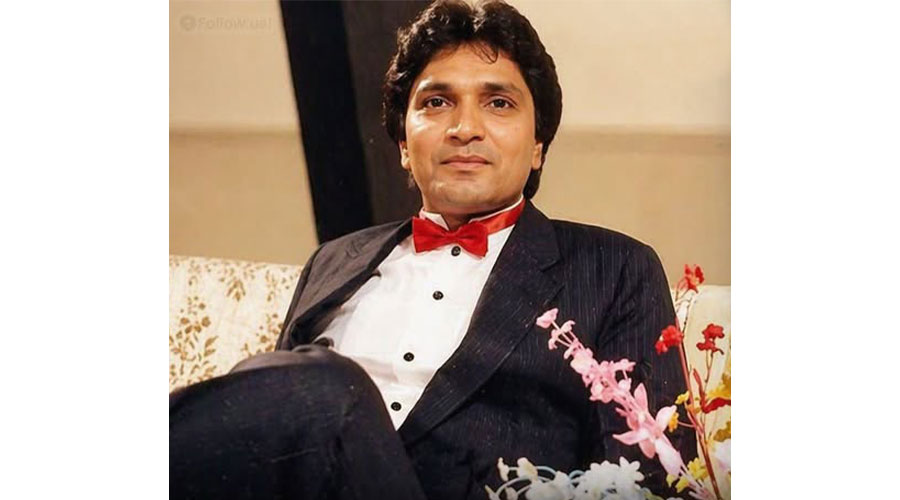
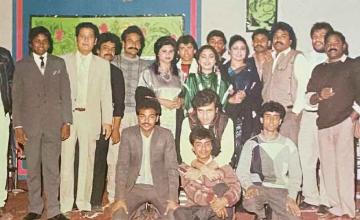
It was 1986. On Tipu Sultan Road in Karachi stood a sprawling bungalow owned by one of the city’s prominent business families. A show had been organised there to celebrate a family wedding. In those days, it was quite common for families to arrange ghazal evenings, variety shows and concerts as part of wedding celebrations—a tradition that has now become far less common. The host and compère of that particular show was none other than Moin Akhtar. The line-up featured some of the biggest names in Pakistani entertainment at the time, including Moin Akhtar, Fareed Khan, Ismail Tara, Majid Jahangir, Alamgir, Muhammad Ali Shehki, Wahab Khan, Sajjad Ali, Umar Sharif, the Benjamin Sisters and Athar Shah Khan Jaidy, among many others. Fareed Khan was also part of the show and brought me along with him. He introduced me to Moin Akhtar and said, “This is Hanif Raja. He does very good stand-up comedy. Give him a slot in the show.”
Moin bhai flatly refused.
“Brother, I have never seen this young man perform before,” he said. “This is a huge show, and the line-up consists of top-class artists. I cannot take the risk of putting him on. What if he ends up ruining the show?”
Later, Moin bhai called Fareed bhai onto the stage for his performance. Fareed performed for about five minutes and then, without Moin bhai’s permission, called me up on stage. He handed me the microphone and walked off. As he left, he turned to the audience and said, “Listen to this young man for ten minutes. If you don’t like his performance, grab me by the collar!”
Fareed bhai’s unexpected move left Moin bhai visibly annoyed.
But then I started performing. The audience responded immediately. They laughed, applauded and became completely engaged with my performance. Those ten minutes changed the course of my career.
Suddenly, Moin bhai came onto the stage. I assumed he had come to reprimand me. I began to step down, but he grabbed my hand and stopped me.
“Where are you going?” he said. “The audience wants more. Give us another 15 minutes.”
Moin bhai gave me another 15 minutes, but the audience simply would not let me leave. By the time I finally came off stage, I had performed for nearly half an hour. What made it even more remarkable was that I had performed after all the top-class comedians on the bill. My material was fresh and original, and I performed with tremendous enthusiasm. In any case, when God decides to honour someone, the path somehow opens up.
After receiving praise from both the audience and the organisers, Moin Akhtar not only accepted me but appreciated my performance as well. That show proved to be a very important and happy turning point in my showbiz career. That was my first introduction to Moin Akhtar. After that, he became “Moin bhai” to me.
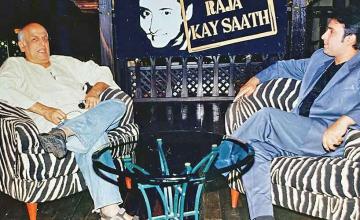
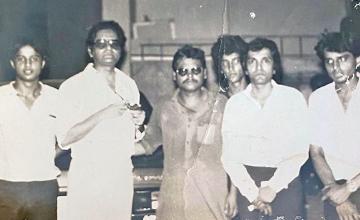
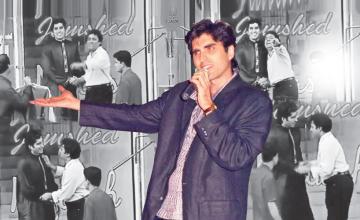
You will see some photographs accompanying this article of Moin bhai and me performing comic sketches together. These were taken during corporate shows, both in Karachi and in other cities.
My first stage play with Moin bhai was Excuse Me Baba, staged at Karachi’s Rio Auditorium in 1990. It was only my second stage play, and my character received considerable attention. It is an interesting coincidence that this important early experience in my stage career also happened to be with Moin Akhtar. I have no idea where the photographs from that play, and from some of the other stage productions I did with Moin bhai, have disappeared. Whatever photographs I still have are presented here.
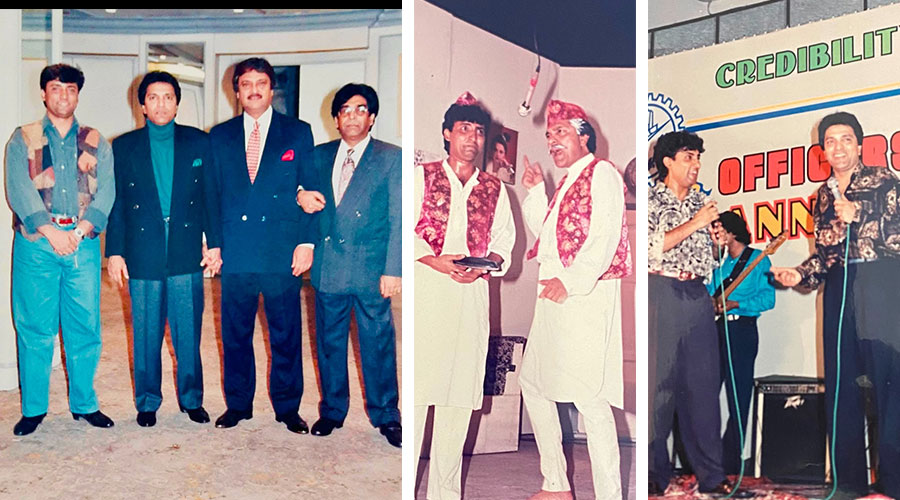
In some of the photographs, Moin bhai and I may appear as singers. These are from the stage play Good Luck Moin Akhtar, directed by Syed Furqan Haider. In the play, Moin bhai and I portrayed fake singers who were also brothers. He played “Ustad Banne Khan,” while I played “Ustad Nanhe Khan.” Ruby Niazi played Moin bhai’s heroine, while Aram Tahir was my heroine. It was a wonderfully entertaining play. Both Good Luck Moin Akhtar and Excuse Me Baba are available on YouTube and have received millions of views.
One day, we were rehearsing Good Luck Moin Akhtar. There was a parody of a song in the play that Moin bhai and I had to perform together. He was supposed to sing one part and I was to sing the other.
The song was set in Jhap tal, a fairly difficult rhythmic cycle. I am naturally quite comfortable with rhythm, but singing in Jhap tal was proving difficult for me. I kept losing the beat and falling out of rhythm.
At the same time, set designer Salahuddin “Charagh” was working on the stage set. Wooden pieces, some about a foot and a half long, were scattered around the stage. Moin bhai picked up one of them. Every time I went off beat, he would give me a sharp tap on the calf with the piece of wood.
“Moin bhai, that hurts!” I protested.
“That’s exactly why I’m hitting you,” he replied.
In the middle of all this joking and mock punishment, I eventually found the rhythm. We went on to perform 20 successful shows of the play, with smiles on our faces.
To this day, I can sing parodies in even the most complicated rhythmic patterns with ease – all thanks to that memorable little “lesson” from Moin bhai.
They say that you truly discover a person’s nature when you travel with them. I travelled extensively with Moin bhai, both within Pakistan and abroad, for various shows. In 1998, I made my first tour of England and Europe with him. After that, I travelled with him several more times to Canada and England. Singer Shaukat Ali, singer Mehnaz and other artists were also part of some of these tours. Moin bhai would play practical jokes during our travels – and often drag me into them as well.
During one of our tours of England, we were travelling by road from London to Manchester. We stopped at a cafe along the way for coffee and sandwiches. On the table next to ours was a stack of beautiful, cup-shaped ashtrays.
The tabla player accompanying the ghazal singer Shaukat Ali was also travelling with us. He and I had become quite friendly, and we often played jokes on each other. He was a mischievous man himself and loved making witty remarks, although he was somewhat timid. He was particularly nervous about being outside Pakistan and was constantly worried about the strictness of British laws. Our coffee and sandwiches arrived.
Looking at the cup-shaped ashtrays, the tabla player asked me, “Hanif Raja, what are these cups for?”
Before I could answer, Moin bhai said, “You put ketchup in them.”
He winked at me and placed one cup in front of himself, one in front of me and one in front of the tabla player. The tabla player immediately filled his “cup” with ketchup and began dipping his sandwich into it. Meanwhile, Moin bhai started tapping the ash from his cigarette into the “cup” in front of him – the ashtray. A waiter standing at a distance watched all this with growing confusion.
The tabla player turned to Moin bhai and said, “What are you doing? The waiter is watching us. What if he gets angry and calls his manager? You’re putting cigarette ash into the ketchup cup!”
Moin bhai looked at him and said, “Son, he’ll be angry because you are putting ketchup into an ashtray and completely ruining it. Under the law in this country, you could even be fined £200 for that!”
The tabla player was horrified. He abandoned his half-eaten sandwich, took the tray full of ketchup, washed it thoroughly with soap and put it back where he had found it. The waiter was now even more bewildered. Later, Moin bhai explained the entire prank to him in English. The waiter – and the rest of the cafe staff burst out laughing.
Comedy is not something that can simply be taught by holding someone’s hand and showing them how to do it. A comedian has to observe senior performers and develop the craft through his or her own abilities. It is less about being taught and more about understanding. Only the fortunate get the opportunity to spend time in the company of legendary seniors, and I consider myself one of those fortunate people.
Moin bhai had an exceptional sense of timing and a remarkable ability to deliver – and create – advice-laden and sarcastic lines. His programme Loose Talk remains one of the finest examples of this. He was a truly versatile artist. Moin bhai had a separate room built on the rooftop of his house in Gulshan-e-Iqbal, Karachi. I spent many hours there under his guidance, writing comic sketches and scripts.
In 2001, Satish Anand of Eveready Pictures planned to produce a comedy television play for Eid titled Eid A-Class. I wrote the entire play in a single night, sitting in Moin bhai’s room.
Moin bhai was supposed to direct it. Unfortunately, Eid was just around the corner, and there was not enough time or studio availability for recording and editing. The project was therefore cancelled.
Otherwise, viewers would have seen something quite unique: a television play directed by Moin Akhtar and written by Hanif Raja. It would have been a completely new combination. In any case, I spent some wonderful years with Moin bhai. When I received the news of his death, I was in Okara for a corporate show. The news left me deeply saddened. I still think of Moin bhai often.
May Allah grant Moin Akhtar bhai endless mercy and forgiveness.
Ameen.





COMMENTS