THE PRANK THAT CHANGED PAKISTANI TELEVISION How “Kaisa” became a television sensation
- 19 Sep - 25 Sep, 2026



In last week’s article, I shared some of the stories and memories surrounding my prank shows Kaisa and Chhup Chhupa Ke. That account, however, was far from complete. So, here is the rest of the story.
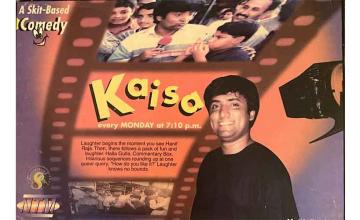
As I mentioned last week, Kaisa and Chhup Chhupa Ke were both creations of yours truly, Hanif Raja. Pakistani audiences were first introduced to the unique prank show Kaisa in December 1996. It was unlike anything they had seen before – a distinctly Eastern interpretation of the prank-show format, filled with innovative and unusual segments. Within just a few weeks, Kaisa’s viewership had soared, and I became widely known across the country.
Last week, I shared two amusing stories involving singer Sajjad Ali and actress Mishi Khan. There is another rather entertaining episode, this time involving me.
For one prank, I had written a scenario in which I would disguise myself as a railway porter and carry out the prank at a railway station. After making all the necessary preparations, we reached Karachi Cantt Railway Station and obtained permission from the station master to begin filming.
The make-up artist did such an impressive job with my disguise that even I could barely recognise myself. I borrowed a porter’s red uniform and turban and stationed myself near the canteen at Cantt Station. I began looking for people who were frustrated because they could not get train tickets and discreetly offered to arrange tickets for them on the black market. Meanwhile, our hidden camera, positioned at a distance, was recording everything.
Soon, people interested in buying black-market tickets began gathering around me. What we did not realise was that at sensitive locations such as railway stations and airports, police intelligence personnel also keep a close watch on people, often while dressed in plain clothes.
In the middle of the prank, I suddenly felt the pressure of two enormous, heavy hands gripping my shoulders from either side. I glanced sideways and, judging from the size and weight of those hands, immediately realised that they could only belong to the long arm of the law.
Two plain-clothes policemen had grabbed me from both sides and taken me into custody.
“Hey! Who are you?” one of them demanded.
“I’m a porter, sir,” I replied.
“What kind of porter are you? Instead of helping people with their luggage, you’re selling them train tickets on the black market?”
Then they noticed that I was not wearing the identification badge issued to registered railway porters. That made them even angrier. They tightened their grip on me and practically dragged me towards the police station located within the Cantt Railway Station premises. I tried to explain.
“Sir, I’m recording a prank show called Kaisa. I’m television actor, comedian and host Hanif Raja.”
One of the policemen punched me in the back.
“Are you trying to defame Hanif Raja as well?”
And with that, they took me to the police station and began announcing loudly, “This porter was selling tickets on the black market! He is highly suspicious because he doesn’t even have an identification badge.”
Soon, I was being slapped from every direction.
Just then, the officer in charge arrived. I told him who I was and rubbed some of the dark-brown make-up from my face with my fingers to show him. That finally stopped the policemen. Once I had cleaned myself up and my real appearance became visible, the officer treated me with considerably more respect. He offered me a chair, had some water brought for me and even ordered tea.
Then he said, “Mr Hanif Raja, you should have obtained a proper permit before filming.”
“But sir, we had already taken permission from the station master,” I explained.
The officer replied, “Written permission is required for any kind of shooting or recording at a railway station. At the very least, the police station or post within the railway station must be informed.”
Our camera and videotape were confiscated. We were told that they would first be shown to senior officers and would only be returned after permission had been granted.
We eventually learned why the authorities had reacted so strongly. At the time, a campaign against black-market ticketing was underway, and our prank happened to portray me as someone actually selling tickets illegally. That was why the situation had become so serious. Fortunately, after the intervention of NTM, the channel on which Kaisa was broadcast, our camera and tape were eventually returned.

Another particularly amusing incident involved actor Adnan Siddiqui. I dressed Adnan in a traffic police uniform and stationed him along Shahrah-e-Faisal. I then sat at a distance in a car with my camera crew and began recording the prank.
Adnan performed the prank brilliantly. He would stop motorists and ask one to recite numbers backwards from 100, while demanding that another recite the national anthem. Anyone who made a mistake would be given a mock traffic ticket.
Adnan was following my script exactly, while my team and I sat inside the car, thoroughly enjoying ourselves as we filmed everything. The funniest moment came when Adnan stopped two young men riding a motorcycle. Because of his disguise, they failed to recognise him and assumed he was an ordinary traffic constable. They began trying to intimidate him by speaking a strange mixture of broken English and exaggerated confidence. Adnan, who was educated at a convent school, suddenly responded in fluent, rapid-fire English. The young men were completely silenced. But the real climax of the prank came a little later.
Adnan was still performing in his police uniform when an inspector from the traffic police post in the same area happened to pass by. He noticed Adnan’s strange behaviour, became suspicious, turned around and came back to question him.
“Who are you? Show me your identification.”
Adnan suddenly became nervous and started fumbling for answers. The inspector noticed the car in which the cameraman and I were sitting and demanded to know what was going on. Adnan pointed towards our vehicle and began calling out to me. I deliberately ducked down beneath the steering wheel and hid.
Adnan kept insisting to the actual traffic inspector, almost swearing on his life, that Hanif Raja was sitting in the car with a camera and that we were recording a prank for Kaisa. But because I was hiding, the inspector became even more suspicious.
“Neither Hanif Raja nor a camera is visible in that car. You’re lying!”
He then grabbed Adnan by the arm and ordered him to come to the traffic police post. I was enjoying Adnan’s growing panic while simultaneously recording the entire scene on camera.
Eventually, I came out of the car – with the camera in hand – and explained everything. I introduced Adnan to the inspector and told him that he had failed to recognise the actor because of the disguise. And that, quite unexpectedly, became one of the funniest segments we ever recorded. All these segments are available on my YouTube channel and Facebook page, “Hanif Raja.”
For another prank, I turned singer Tahseen Javed into a petrol pump attendant. He played the role exceptionally well. One particular customer – who, judging from his mood, had perhaps left home after an early-morning argument with his wife – angrily ordered Tahseen to fill his car with petrol. He handed Tahseen the key to open the fuel cap. Tahseen opened the cap, secretly kept the key in his hand and then calmly told the customer, “Sir, your car key has fallen into the petrol tank.”
The already furious man completely lost his temper. He had apparently left home after receiving an earful from his wife, and now his anger seemed to be reaching boiling point. He was so enraged that it looked as though he was about to beat Tahseen Javed up. I immediately rushed over, revealed the prank and somehow managed to calm the man down before sending him on his way.
Kaisa was broadcast on NTM. However, the channel itself was plagued by administrative disputes and was shut down several times before reopening. Eventually, in 1999, the channel closed down permanently. By that time, around 100 or more episodes of Kaisa had been broadcast.
The show also travelled far beyond Pakistan. Its VHS tapes were sold through Karachi’s popular Rainbow Centre in Saddar and found their way to viewers around the world, including India.
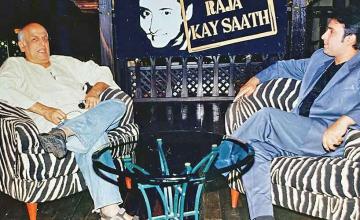
Then came Chhup Chhupa Ke. It was essentially a new version of Kaisa, with some changes and a fresh approach. I launched it on a private satellite television channel around 2003 or 2004, and the show remained on air for approximately a decade. During Chhup Chhupa Ke, I experimented with another idea. At the same satellite channel where Chhup Chhupa Ke was being broadcast, I had also started a light-hearted talk show called Raja Ke Saath.
Whenever a well-known celebrity appeared as a guest on Raja Ke Saath, I would take advantage of the cameras already present on the set – and already rolling – and pull an impromptu prank on the celebrity.
These pranks were so sudden and spontaneous that the celebrity barely had time to understand what was happening, let alone prepare a response. Among the celebrities who fell victim to these pranks were film star Reema, film star Rambo, actress Jiya Ali, actor Yasir Nawaz and actor Shehzad Raza, among others. These segments can also be viewed on my YouTube channel, “Hanif Raja.”
You may have noticed a similar style of suddenly pranking a guest during a talk show on a popular Indian comedy programme. At the time, Pakistani television channels were not generally available on Indian cable networks. However, people in India could watch Pakistani programmes through various satellite receivers and digital channel boxes. Interestingly, an Indian private satellite television channel produced a prank show called Chhupa Rustam, which was essentially a copy of Chhup Chhupa Ke. The resemblance was striking. Whenever I aired a particular segment on Chhup Chhupa Ke, a copied version of the same idea would often appear on the Indian prank show the very next week.
Several Pakistani television channels also copied Kaisa and Chhup Chhupa Ke almost word for word and frame for frame. And the tradition of reproducing these ideas continues today, particularly on social media. There are more than 2,000 segments from Kaisa and Chhup Chhupa Ke, along with countless amusing stories and incidents associated with them. It is simply impossible to recount all of them in a single article.
That is why, in response to repeated requests from my viewers and readers, I am compiling these memories into a book. The title of the book will be “Safar Jaari Hai” – “The Journey Continues.”







COMMENTS