Prime Minister Shehbaz Sharif and Federal Minister for Health Syed Mustafa Kamal
- 07 Nov - 13 Nov, 2026


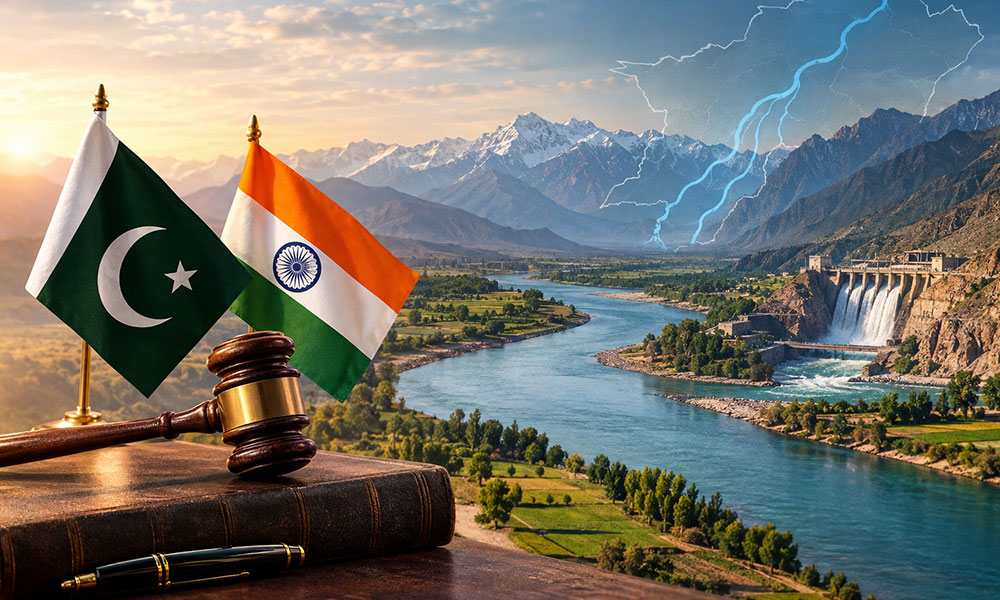
Water is the essence of life and the foundation of prosperity, agriculture and human survival. For Pakistan, the rivers of the Indus Basin are not merely waterways; they are the lifeline of agriculture, irrigation, hydropower, food security, ecosystems and millions of rural livelihoods. Since Pakistan’s creation, however, the sharing of these waters has remained a serious concern because of disputes over their flow and use.
The Indus Waters Treaty (IWT), signed between Pakistan and India on September 19, 1960, was intended to establish a durable framework for managing these shared waters. For sixty-six years, the Treaty survived wars, military confrontations, political hostility and prolonged periods of strained relations. India’s unilateral decision to place the Treaty in abeyance challenges that historic principle. Transboundary rivers require predictability, cooperation and responsibility. When an established mechanism governing shared waters is weakened, uncertainty can affect agriculture, food systems, energy security, livelihoods and ecosystems. For Pakistan, where the Indus river system forms the backbone of national life, uncertainty surrounding treaty-based water management carries consequences far beyond diplomacy.
Sustainable management of shared rivers requires upstream development and water use to remain consistent with established legal obligations and downstream interests. The Indus Waters Treaty endured decades of conflict because water security was treated as a shared strategic responsibility rather than an instrument of political pressure.
Climate change makes cooperation even more essential. Glacier melt, extreme precipitation, droughts and changing river patterns are increasing hydrological uncertainty across South Asia. These challenges demand stronger mechanisms for data-sharing, flood coordination, drought preparedness and sustainable basin management. Weakening established safeguards risks adding human-made uncertainty to natural variability and increasing the vulnerability of millions.
Water must remain a bridge between communities, not an instrument of geopolitical coercion. If shared rivers become tools of political pressure, the consequences may extend beyond Pakistan and India. The credibility of transboundary water governance could be weakened. Every downstream country dependent upon a shared river could face greater uncertainty if upstream states were able to disregard established arrangements whenever political relations deteriorated.
The legal implications are equally significant. The principle of pacta sunt servanda requires treaties to be respected and performed in good faith. The strength of international law is tested not during periods of peace, but when relations are under pressure. A treaty that survived six decades of conflict should not be rendered ineffective through unilateral political action. India’s attempt to place the IWT in abeyance therefore raises fundamental questions concerning the sanctity of international agreements.
The history of the IWT itself proves that shared rivers can remain governed by law even when political relations become deeply strained.
The Hague Award represents an important development in this context. The ruling reaffirmed that the Indus Waters Treaty remains in force and cannot be placed in unilateral “abeyance.” The Treaty contains no provision permitting unilateral suspension, termination or abeyance. The Award therefore reinforces the principle that a political declaration cannot by itself displace binding treaty obligations.
Non-participation cannot create a legal veto over an established international dispute-resolution process. Nor can refusal to engage with such mechanisms become an acceptable precedent for states seeking to avoid international adjudication.
The Award also reaffirmed that India’s rights concerning hydro-electric development on the Indus, Jhelum and Chenab – the Western Rivers – are treaty-defined rights rather than unlimited sovereign discretion. India may undertake permitted run-of-river hydro-electric projects, but their design and operation remain subject to the Treaty and its dispute-settlement framework.
The accompanying unanimous Order concerning the Ratle Hydroelectric Plant further demonstrated that treaty compliance has practical consequences. Interim measures restricted specified construction activities pending the Neutral Expert’s decision and required reporting regarding changes to the construction schedule. Such measures underline the continuing relevance of the Treaty to infrastructure development and water management.
The significance of this issue extends far beyond Pakistan and India. If an upstream state could unilaterally suspend a water-sharing agreement whenever political relations deteriorated, downstream states across the world would become increasingly vulnerable to political coercion. The Hague ruling reinforces a broader principle: international agreements governing vital shared resources cannot be displaced merely by unilateral political declarations.
For Pakistan, the Indus is more than a river system. It is the foundation of agriculture, rural livelihoods, food security and national economic life. The legal reaffirmation of the Treaty provides reassurance that the framework governing these waters remains intact. Yet water security in an increasingly climate-stressed region requires predictability, transparency, cooperation and respect for international law.
After sixty-six years, the Indus Waters Treaty remains a historic example of how law can preserve stability amid political conflict. Its future should be protected through dialogue, legal mechanisms and recognition that rivers sustain people before they serve politics. The waters of the Indus must remain a source of life, stability and cooperation – not another arena in which political disputes threaten the survival and security of millions.














COMMENTS