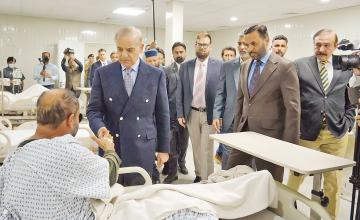
Prime Minister Shehbaz Sharif and Federal Minister for Health Syed Mustafa Kamal
- 07 Nov - 13 Nov, 2026



The Pakistan Muslim League Nawaz has been fortunate to have workers whose loyalty survived its darkest days. They stood beside their leaders in office and remained when power disappeared. Some endured imprisonment, others saw their livelihoods suffer, and some faced threats abroad. Their experiences could fill volumes. Today, let us turn to one such story.
Picture the opening scene. It is the 1990s, and an election campaign is under way. A young man stands before a wall, holding a poster of Nawaz Sharif. He pastes it carefully, smooths its creases with his palm, then steps back to inspect his work. Perhaps he feels satisfied that he has contributed something to his leader’s cause.
That young man is Rashid Nasrullah. He cannot know that this sheet of paper will become a lasting symbol of his life. There is no office awaiting him, no promise of advancement. There is simply a worker and his affection for a leader, sustained by the belief that even a modest effort can help fulfil a larger dream.
The scene shifts to London: education, hard work and the ambition to build a future. Opportunities for employment, business and comfortable living lie ahead. Yet Rashid’s connection with Pakistan and Nawaz Sharif remains intact. Eventually, the young man who once put up posters becomes Nawaz Sharif’s personal secretary during his stay in London. The face he once displayed on a wall is now part of his daily working life. Closeness brings trust, and trust brings responsibility.
The third scene is unsettling. In September 2022, reports emerge of an attack on Rashid while he is travelling to his office in London. According to his police complaint, he was assaulted and threatened with consequences unless he abandoned his support for Nawaz Sharif. Political allegiance has become a question of personal safety.
After such an experience, leaving home the following morning cannot be easy. The streets remain familiar, but one looks at them differently. Family members carry their own anxieties. Readers move on after scanning the news; the person involved must continue living in the same city. Rashid’s loyalty endures.
The fourth scene takes him back to Pakistan. Returning from abroad requires rearranging years of work, relationships and plans. Rashid makes that choice. Maryam Nawaz appoints him her special assistant, entrusting him with responsibilities concerning Zakat and Ushr. His association with Nawaz Sharif continues, but public service now presents another test: the needs of a widow, a child’s education, a family struggling to keep its kitchen running. Trust must translate into practical help.
Rashid’s journey recalls that of Nehal Hashmi, whose association with Nawaz Sharif stretches back more than three decades. In Karachi, where Altaf Hussain and the MQM once exercised formidable influence, publicly carrying the PMLN flag demanded courage. Hashmi maintained his political identity in that difficult environment.
Then came October 1999. Nawaz Sharif’s government was overthrown, he was arrested, and General Pervez Musharraf established military rule. Hashmi remained among those who raised their voices, pursued legal avenues, attended court proceedings and worked to secure access to their detained leader.
Hashmi later experienced imprisonment in a contempt of court case, political setbacks and difficult periods within his own party. His journey nevertheless continued with the same organisation, taking him to the Senate and subsequently, as the original account records, the governorship of Sindh. Recognition of longstanding workers encourages others who have served without immediate reward.
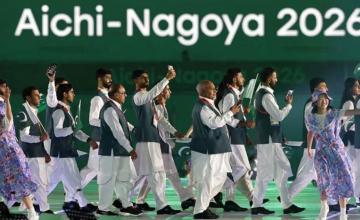
In Japan, Malik Noor Awan’s experience forms another painful chapter. According to his published account, after arriving in Pakistan with Nawaz Sharif in July 2018, he was taken from Lahore airport and severely tortured. His account includes the harrowing claim that he was abandoned near the border, presumed dead. He survived, although physical suffering remained.
Despite that ordeal, his affection for Nawaz Sharif did not diminish. He continued to raise his leader’s slogan with the same enthusiasm. Whatever one’s political views, such persistence reveals the depth of his attachment.
Then came a warmer scene in Japan. During an official visit, Maryam Nawaz made time to visit Malik Noor Awan’s home, meet his wife and children, and hold his grandchild. For a devoted worker, that visit represented affection, recognition and reassurance that the relationship mattered to both sides.
Such moments cannot erase suffering, but they can offer comfort. One hopes that workers like Malik Noor Awan will receive greater recognition for their sacrifices.
Rashid Nasrullah, Nehal Hashmi and Malik Noor Awan form part of their party’s collective memory. Valuing their contribution also encourages the young person standing before a wall today, carefully smoothing a poster and hoping that, one day, his voice will reach the leader he admires.







COMMENTS